Software thatconnects brainheadsets to anyinterface.
For BCI researchers and ML engineers. A headset reads the brain's electrical activity (EEG). Silvia learns one person's patterns, like imagining a left or right hand squeeze, and turns them into commands for any interface: apps, robots or a robotic glove.
How a brainheadsetworks.
Sensors on the scalp pick up the brain's electrical activity: EEG, voltages of 10 to 100 millionths of a volt. When someone imagines squeezing their left hand, the rhythm over the right side of the brain's movement area quiets down, and the other way round. Software can learn that pattern for one person. That's a brain-computer interface (BCI). No surgery, no mind reading.
- 01
Sense
A headset records EEG over the hand areas of the brain, 256 times a second.
- 02
Learn
Silvia learns how one person's EEG changes when they imagine their left or right hand.
- 03
Act
It sends LEFT or RIGHT to an app, a game, a robot arm or a robotic glove.
Today, everyteam builds itfrom scratch.
Every headset streams EEG in its own format, and every app, robot or VR world expects its own commands. So every lab, clinic and startup writes its own code to connect them, again and again.
Connect each headset once. Connect each app or machine once. Silvia handles everything in between.
What Silvialooks like.
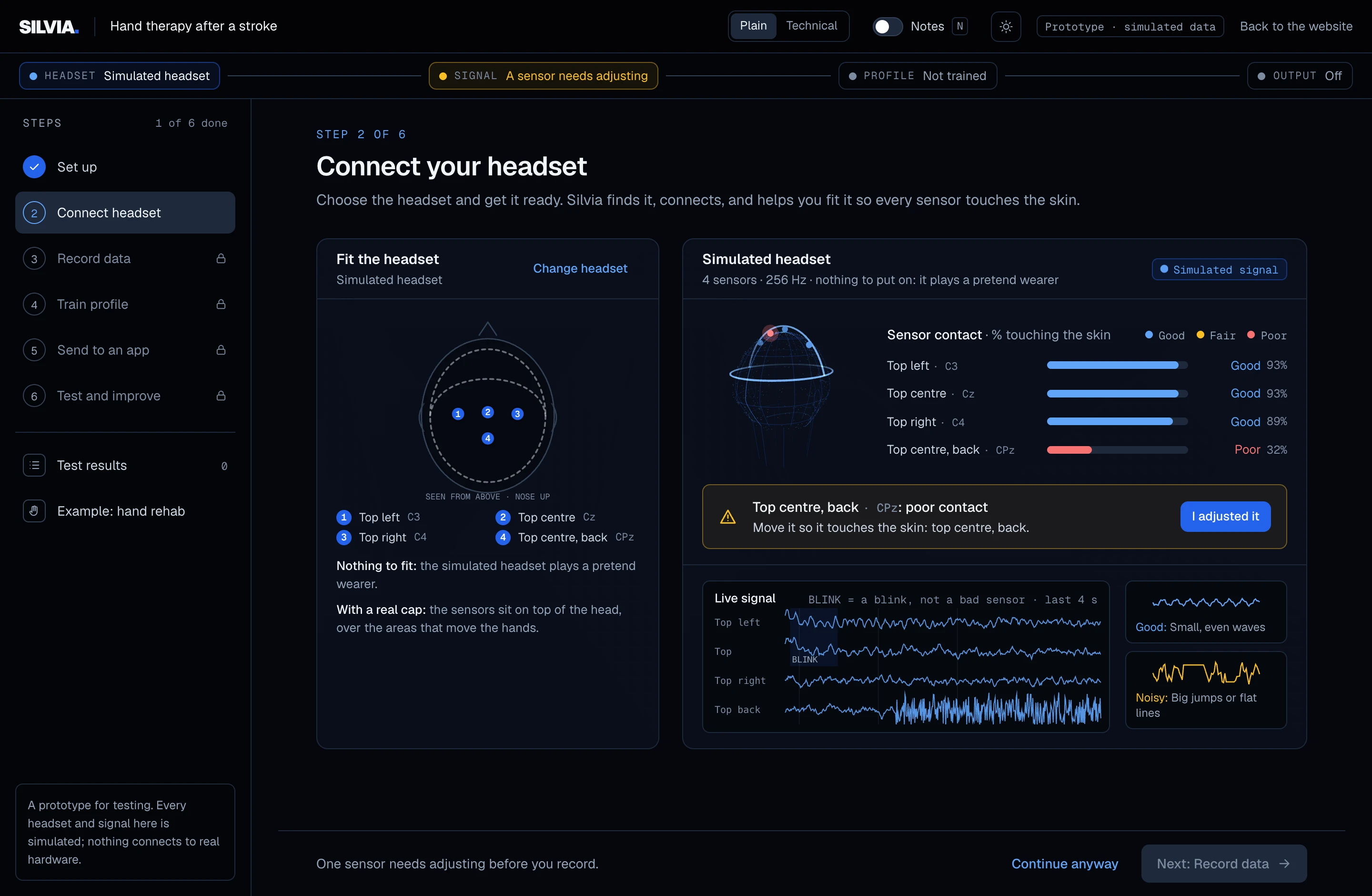
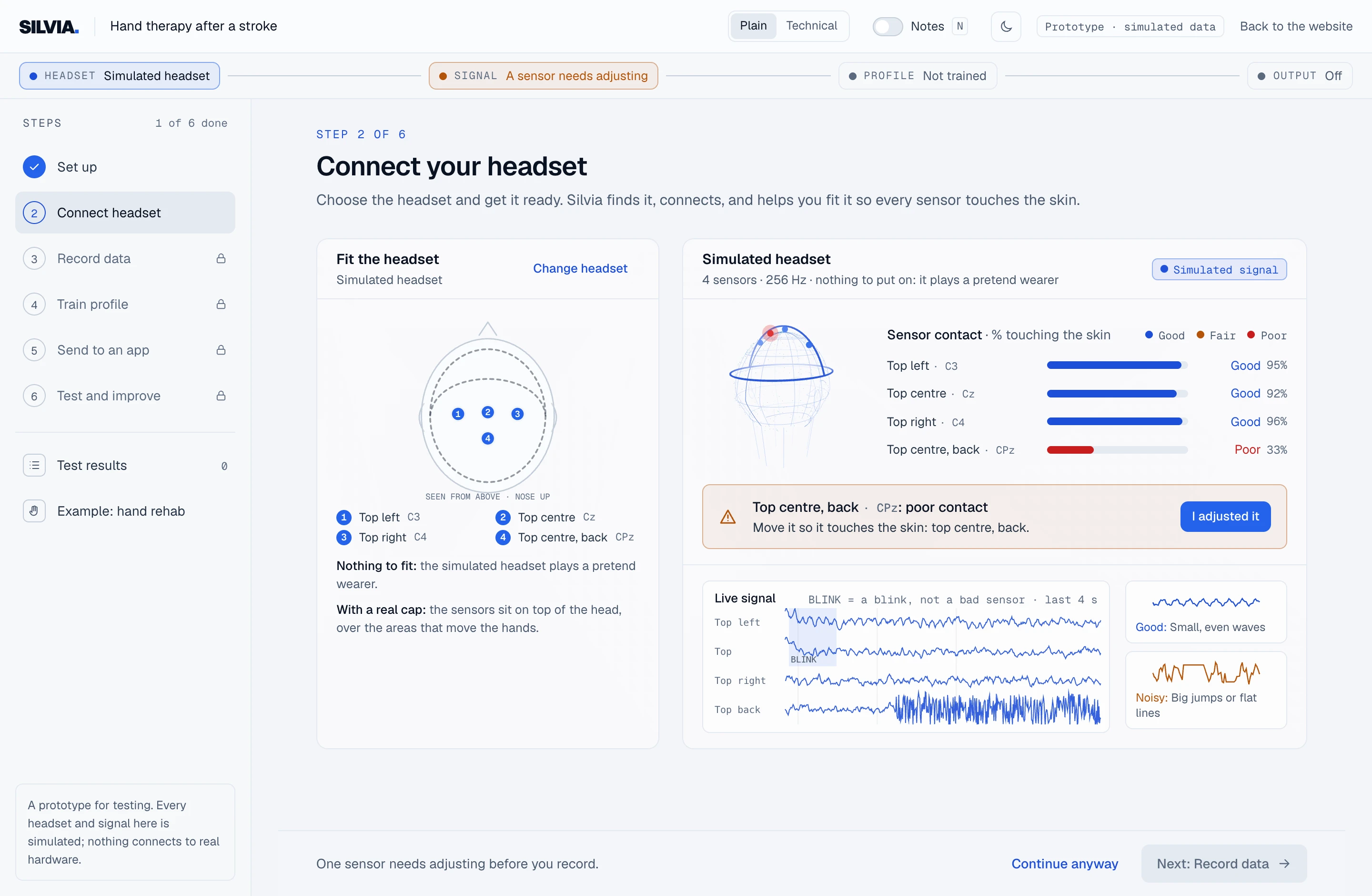
One example, step by step: a rehab team trains a profile for P-07, a patient after a stroke, so that imagining a hand squeeze can drive a robotic glove. Screens from the clickable prototype, with simulated data.
The therapist puts the headset on P-07. Silvia finds it and checks the 4 sensors over the hand areas, one by one.
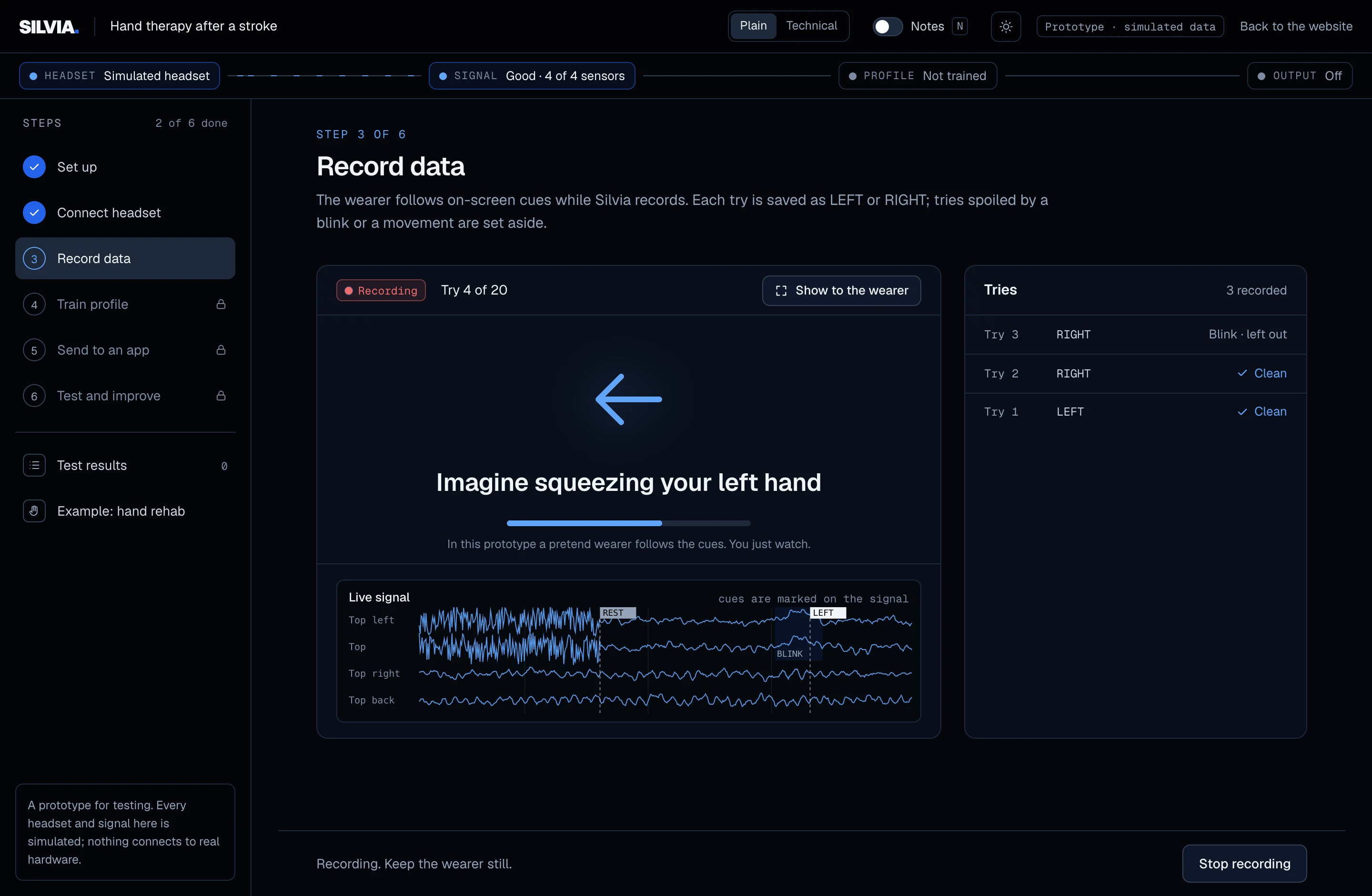
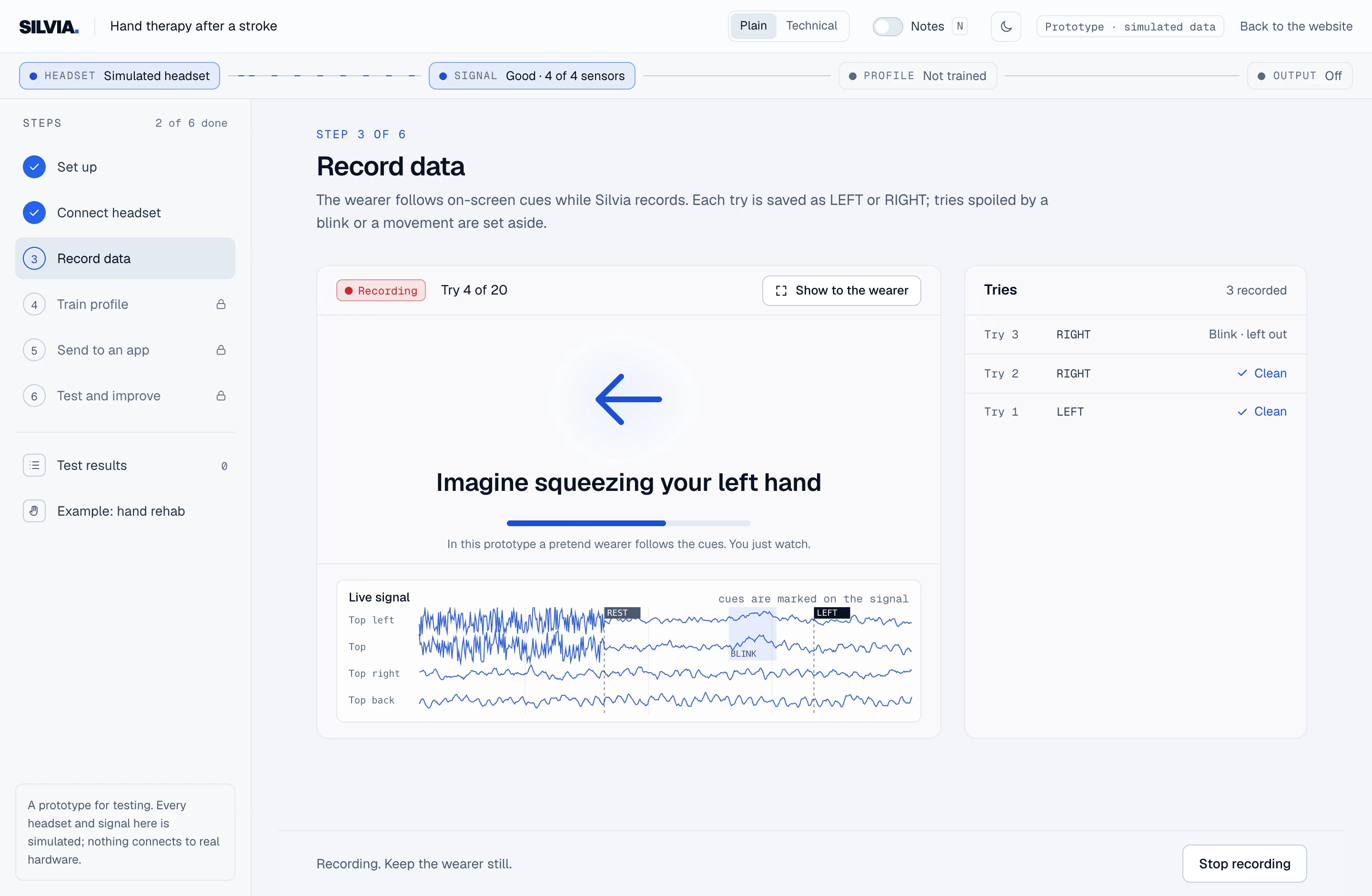
P-07 sees “Imagine squeezing your left hand” or “right hand”, 20 times. Silvia records the EEG of each try and leaves out blinks.
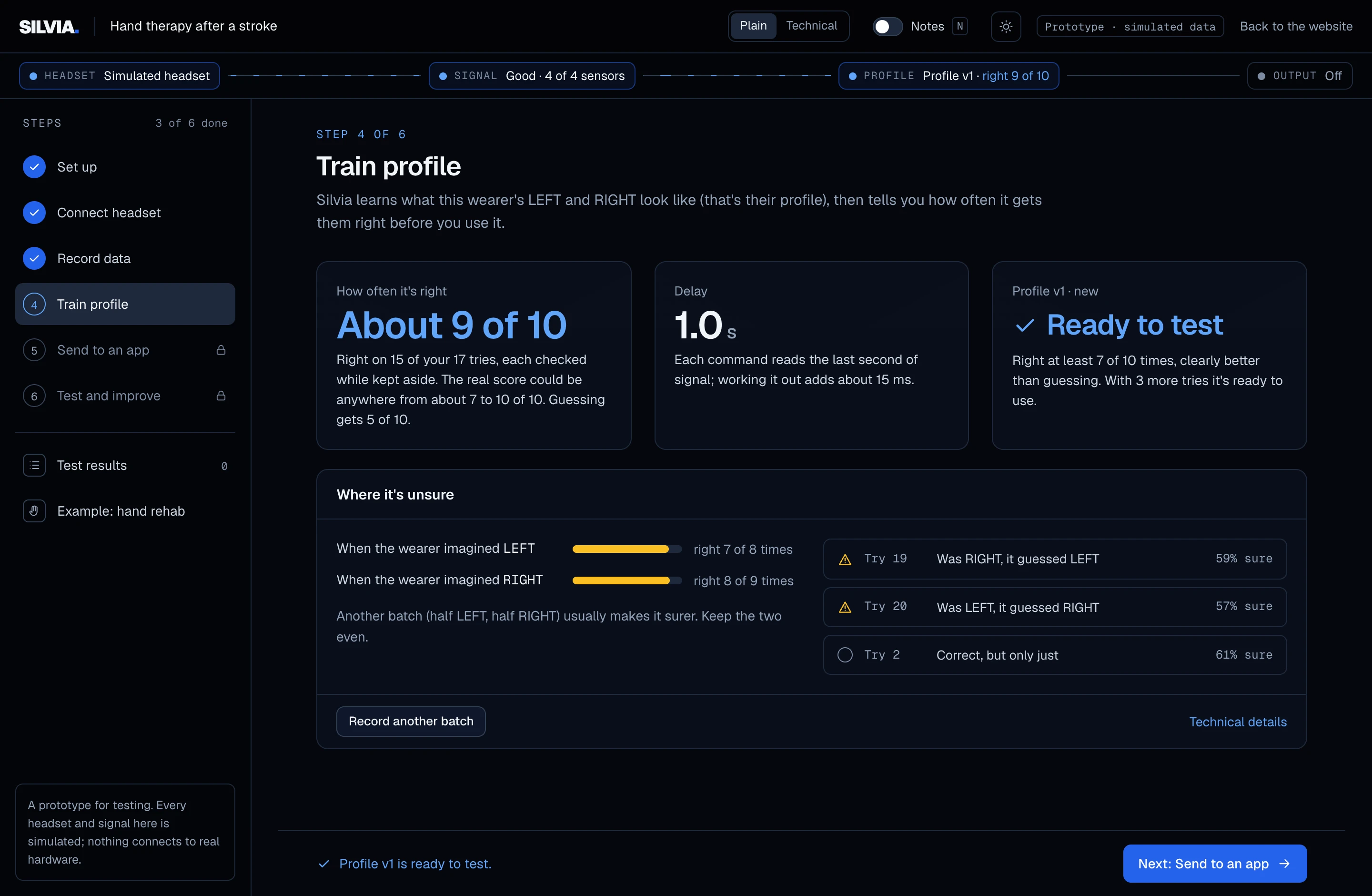
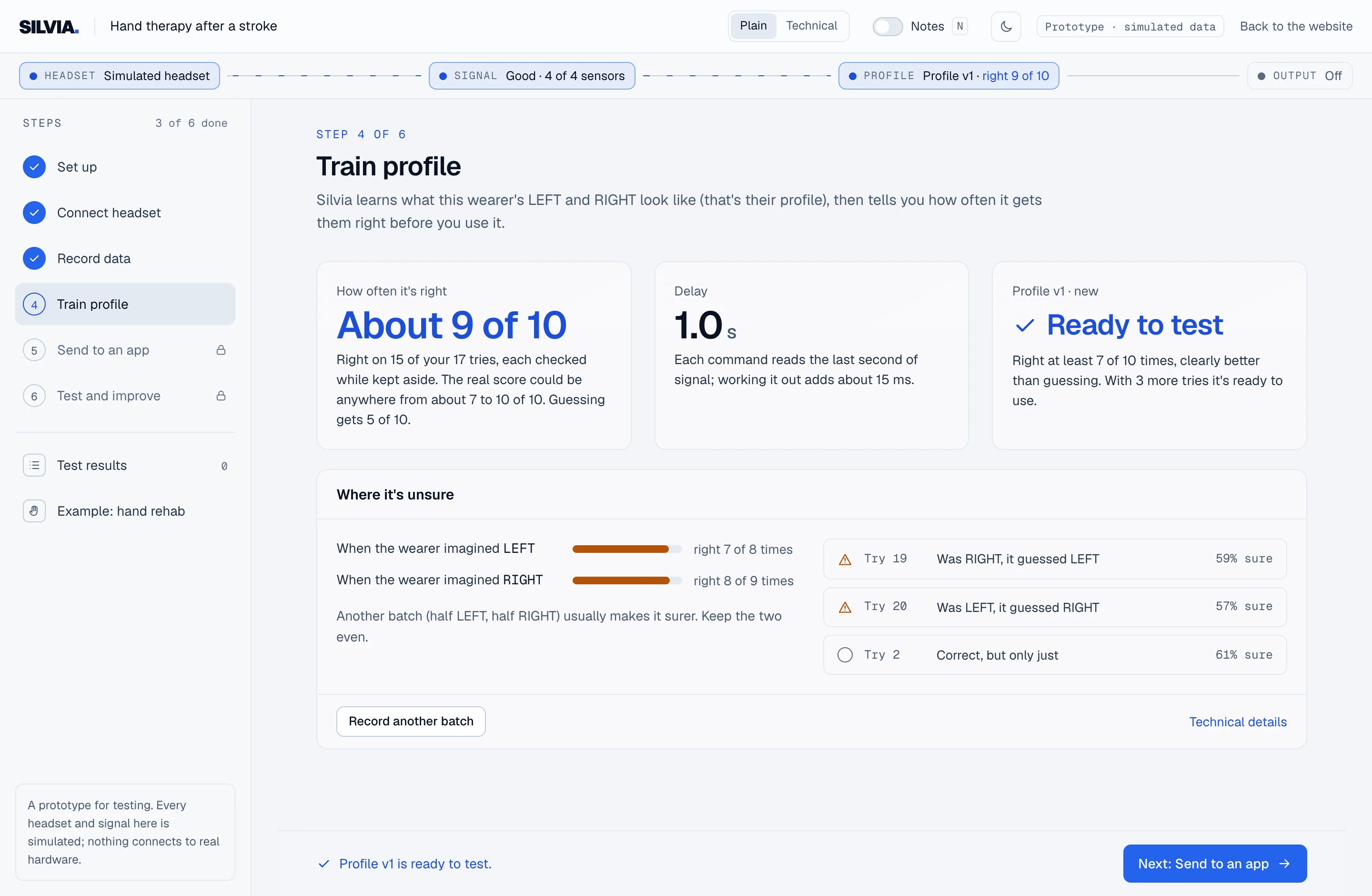
Silvia learns how P-07's EEG differs between left and right, and says how often it gets them right, on tries it didn't learn from.
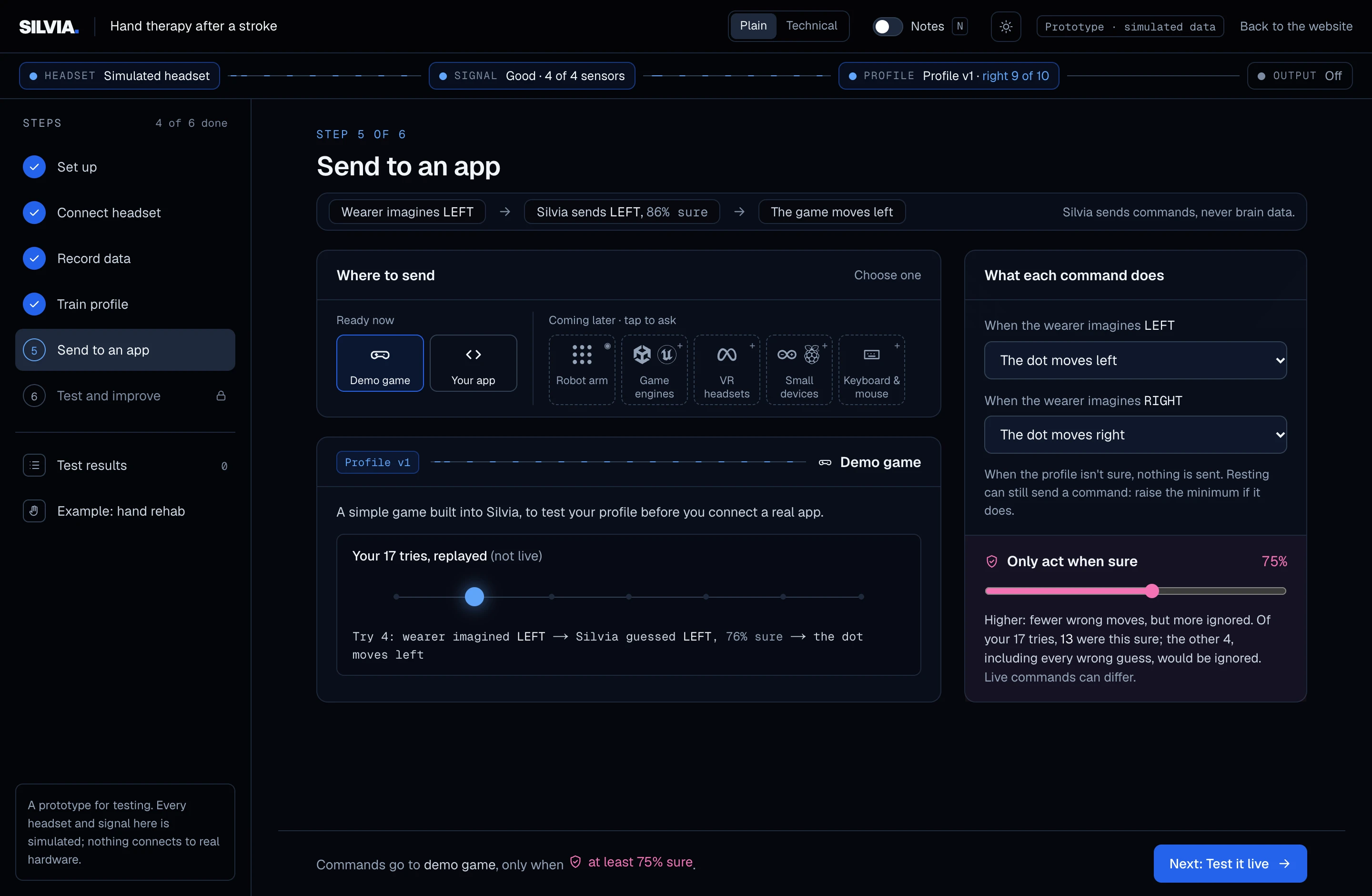
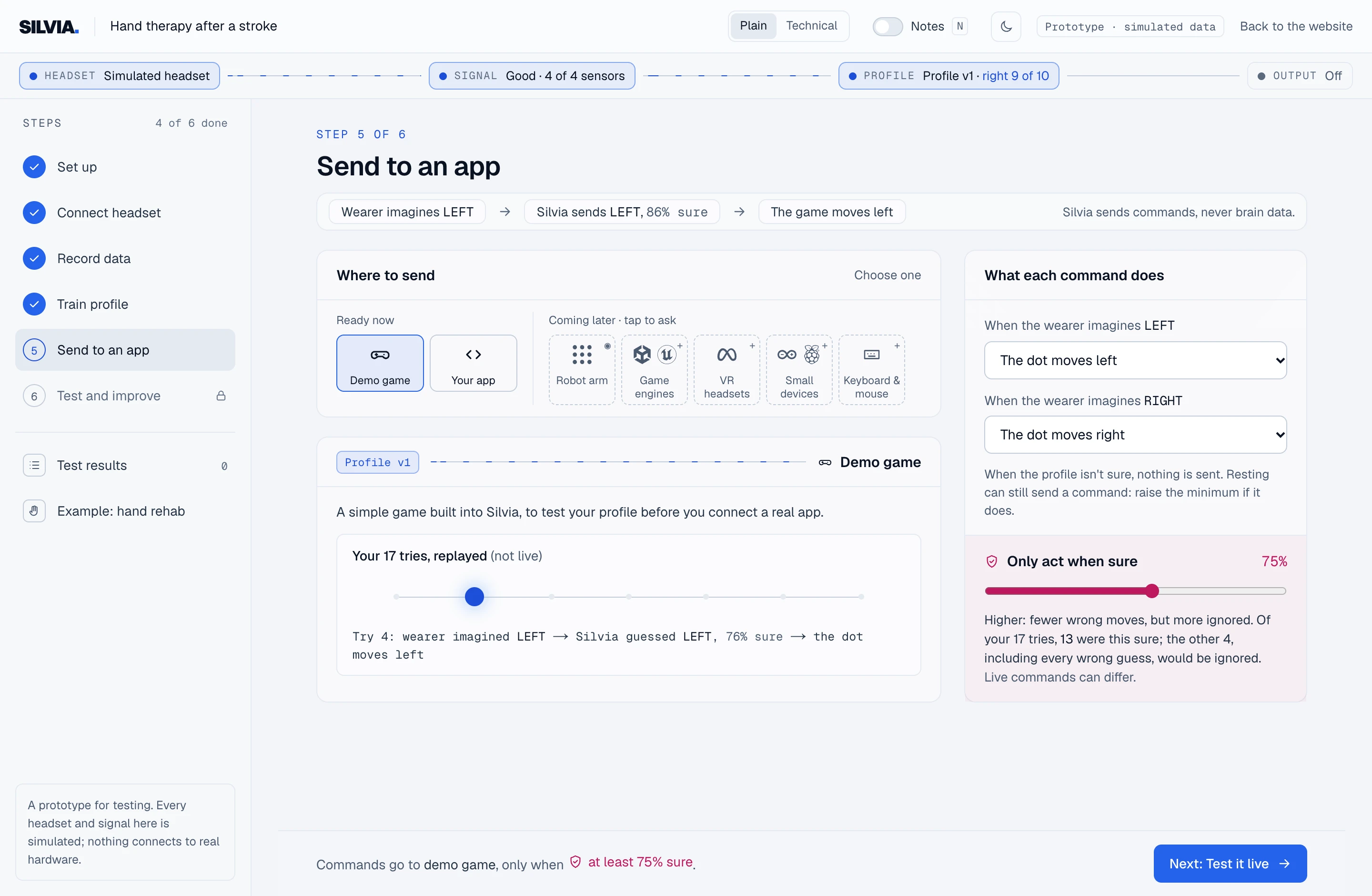
Choose where LEFT and RIGHT go, and how sure Silvia must be before it sends anything: 75% by default.
A live test: P-07 moves a dot to 10 targets by imagining a hand. Then a verdict: is the profile good enough to use?
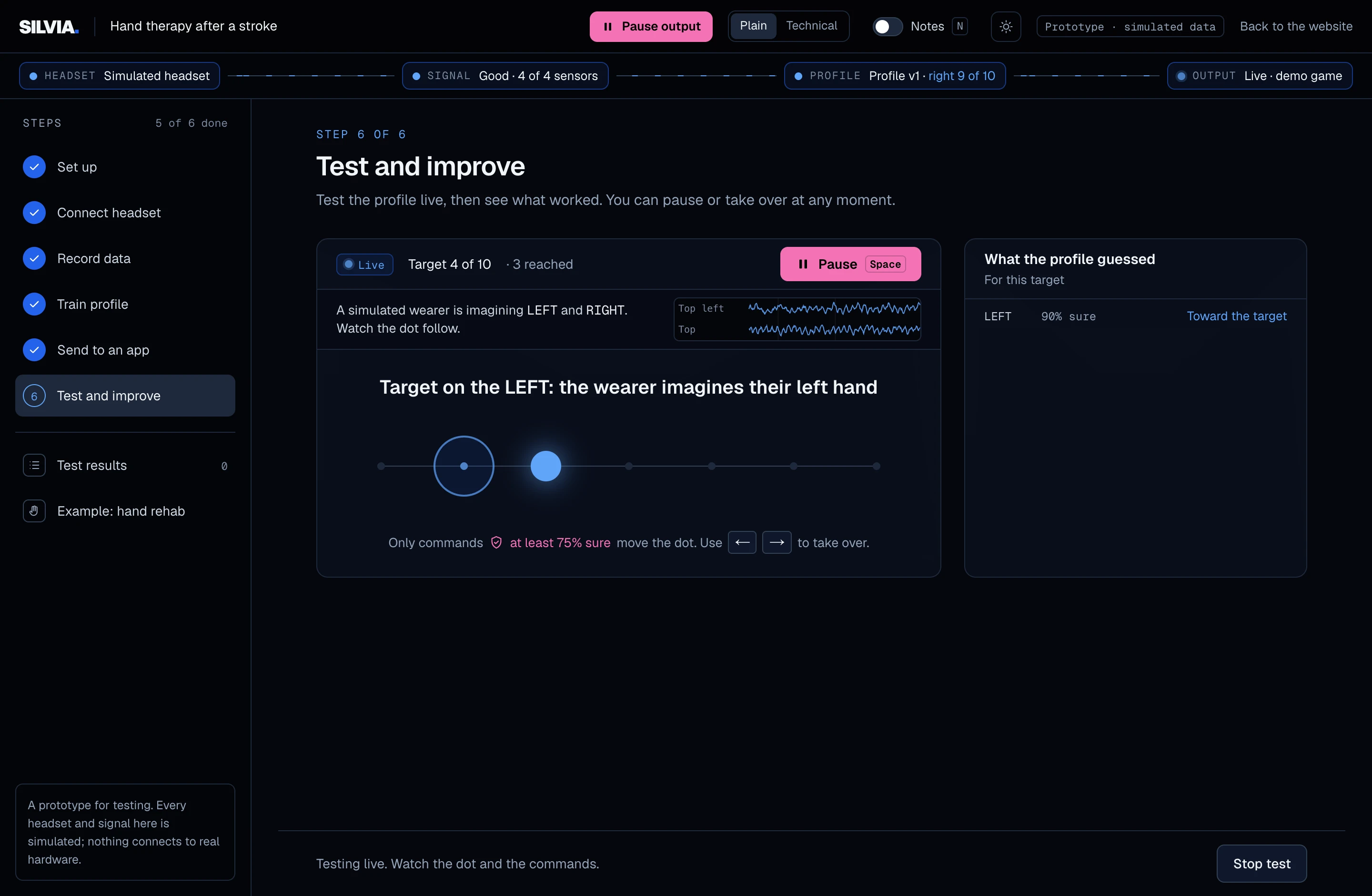
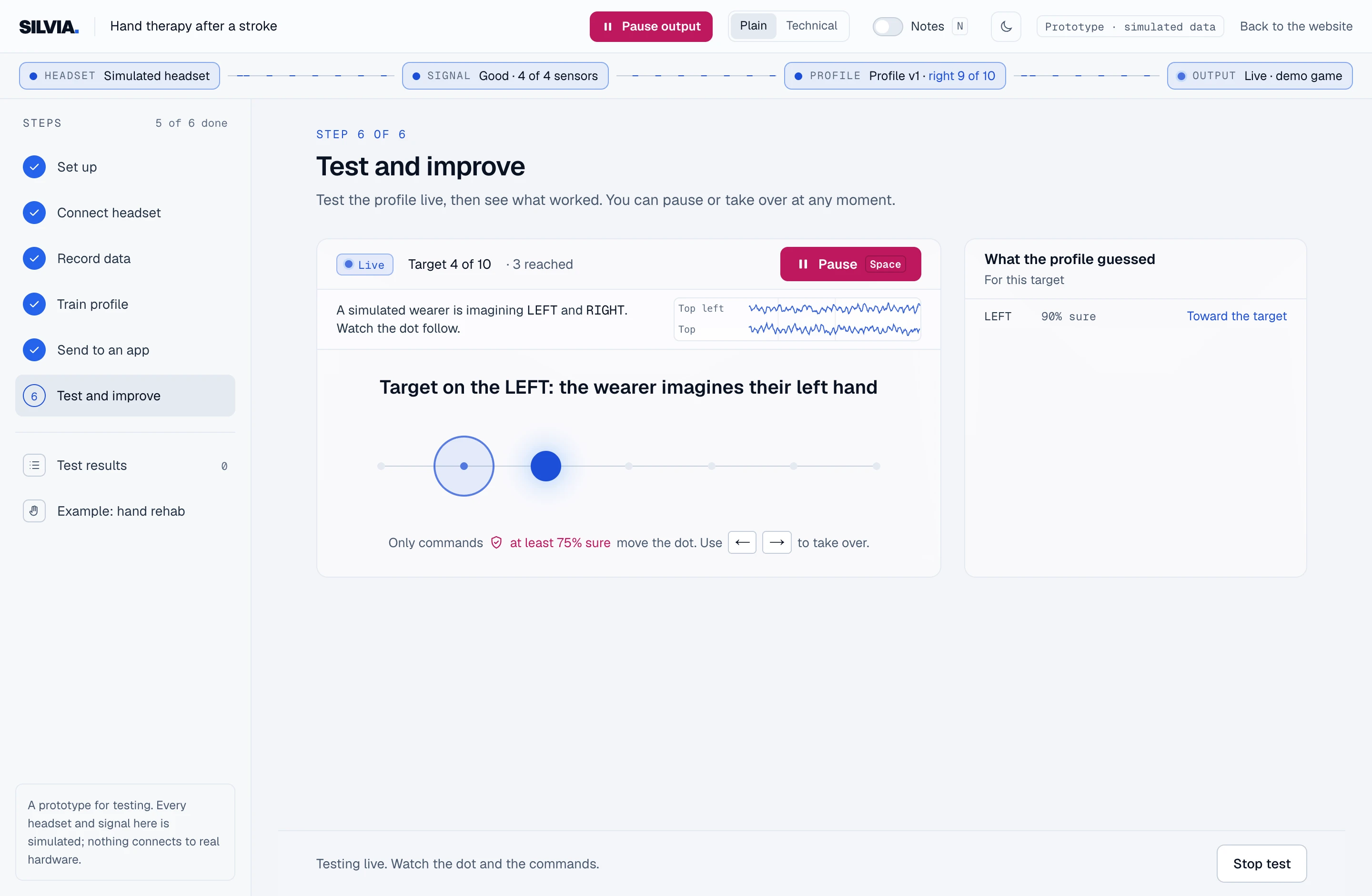
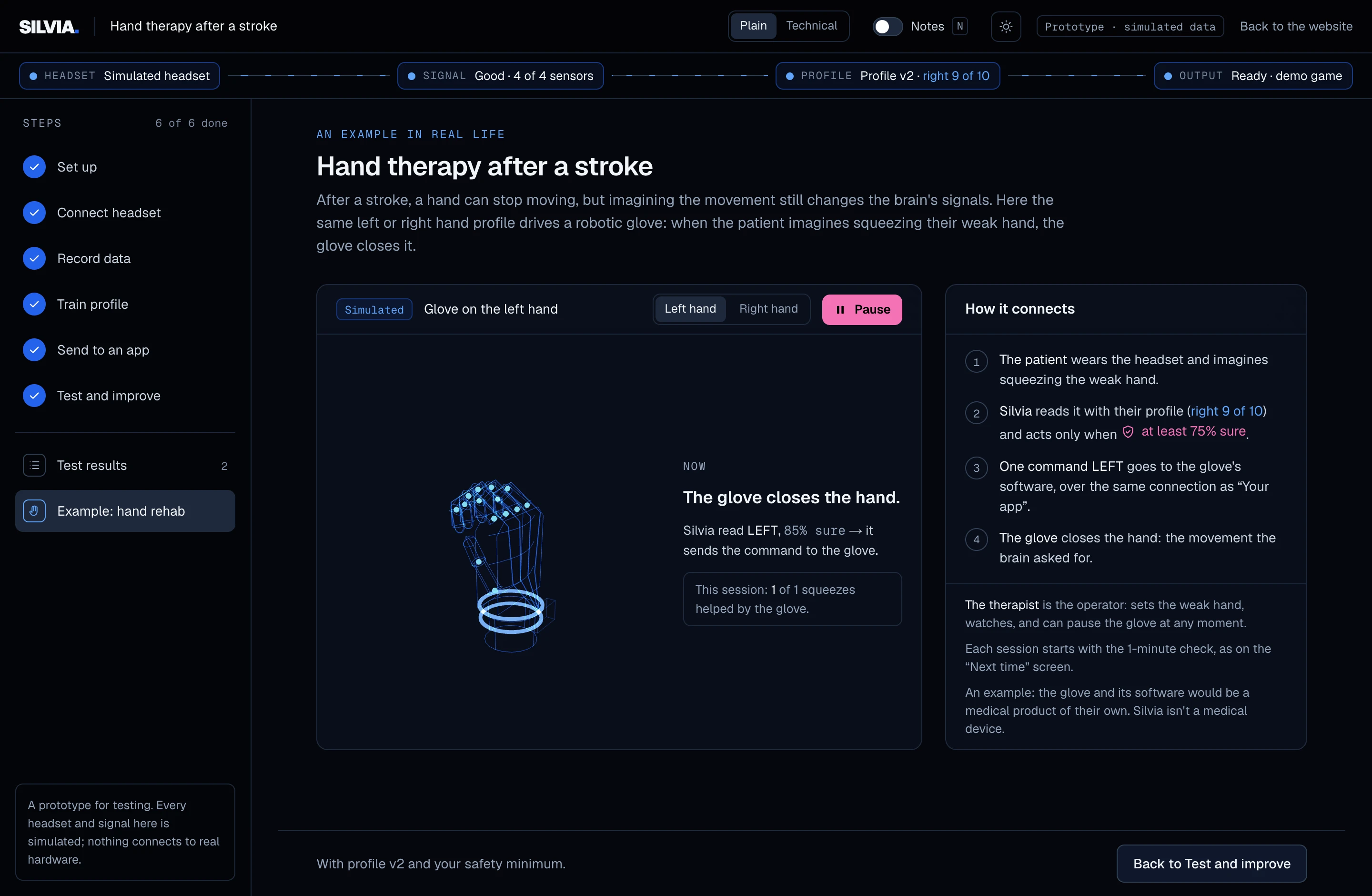
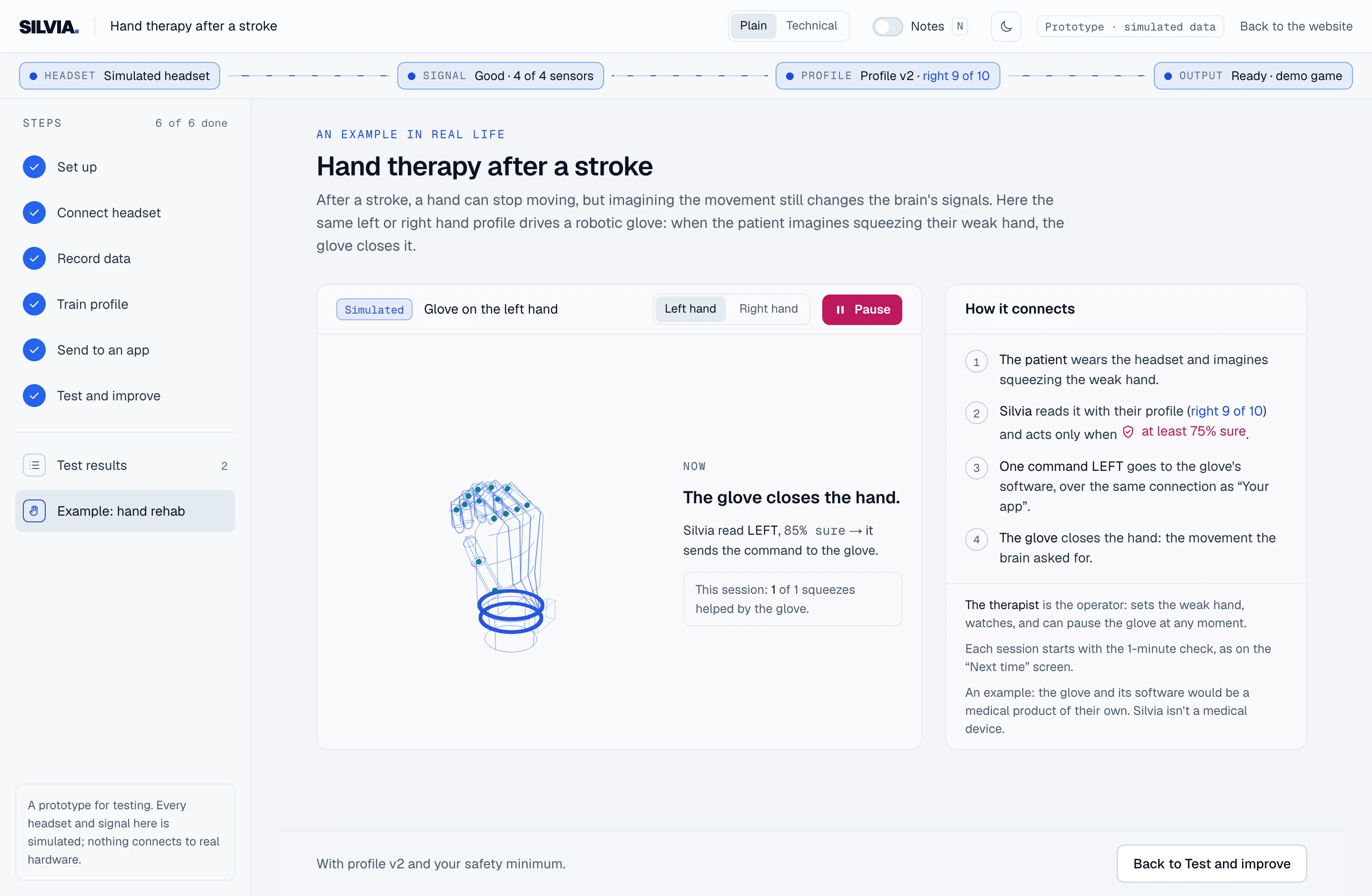
The same profile drives a robotic glove: when P-07 imagines squeezing the weak hand, the glove closes it.
Try the prototype
Click through the whole flow with a simulated EEG headset: connect, record, train, send and test. No hardware needed.
The prototype needs a laptop or desktop screen.
Whoit's for.
Researchers first, then the teams who build on their work. One example each.
- 01Silvia's first users.
BCI researchers & ML engineers
Record EEG from any headset, train a left/right hand profile for each person, and compare test results. No setup scripts.
- 02Collaborators.
Rehab teams
After a stroke, a robotic glove closes the patient's weak hand when their EEG shows they imagine squeezing it.
Silvia is a research and development tool, not a medical device. - 03Collaborators.
Robotics teams
A robot arm turns left or right when the wearer imagines moving that hand. A person can always stop it.
- 04Collaborators.
Software & game teams
A game or an app gets LEFT and RIGHT commands from the player's EEG, without building the EEG part.
Logos show planned integrations. Silvia is an independent project, not affiliated with these companies.
Connect yourapp in afew lines.
You train the profile in Silvia's app, with no code. Your app only listens: Silvia sends one small message for each command, and your code decides what it does.
- Interface
- A WebSocket with JSON messages: any language
- Your app gets
- The command, how sure it is, and when. Not brain data
- Formats
- Works with LSL, BrainFlow and MNE data
- Safety
- Only act when sure, pause and override
- AI assistants
- Planned: Claude and others can read your projects over MCP. Never live commands
Illustrative: the interface is planned, not built yet.
▍What wepromise.
- T.01
Hardware-neutral
We don't sell headsets. We make all of them work together.
- T.02
Human in the loop
A person can always pause, correct or override.
- T.03
No magic
No mind reading. No miracle claims. Just signals, models and results you can inspect.
Private by design
Brain recordings are personal data. Silvia is designed so they stay protected, and so apps get commands, never your brain signals, unless you allow it.
This is how we're designing it. It isn't built yet: the prototype only uses simulated data.
How we plan to handle data
- Storage
- Recordings are stored encrypted, inside your project.
- Access
- Only the people you add to a project can open its recordings. Wearers are listed by a code, not a name.
- Sharing with apps
- Apps receive decoded commands (like LEFT, 86% sure) by default. Raw brain signals only reach an app you explicitly authorise.
- Deleting
- You can delete a recording, or a whole project, at any time.
Questionsanswered.
A plain-language ops manual. Published because the same questions come up every time.
▸ hello@silvia.[tbd]~/SILVIA $ cat FAQ.md ▍
Get earlyaccess.
Silvia is in early development. Leave your email and we'll write to you first when you can try it.